









The next year, which is 2026, will witness the continuation of rapid evolutions in e-commerce. And the major difference will be seen in the AI-driven conversion rate optimisation, or CRO. It’s a lot more different from traditional CRO, which typically resonates with incremental A/B testing and the trial-and-error method for improvements. For real, AI is everywhere today, enabling e-commerce brands to understand the unsaid behaviour of customers at scale. It can smartly predict preferences to recommend with precision. Furthermore, this amazing technology can automate optimisation that sounds more like science fiction.
AI-driven CRO can be considered a massive shift that redefines how brands integrate digital marketing. Additionally, it has completely dispelled the notion of relying on intuition or guesswork. Everything it suggests is through data-driven decision-making to deliver dynamic experiences while personalising e-commerce journeys.
The Evolution of CRO: From Static Testing to Intelligent Optimisation
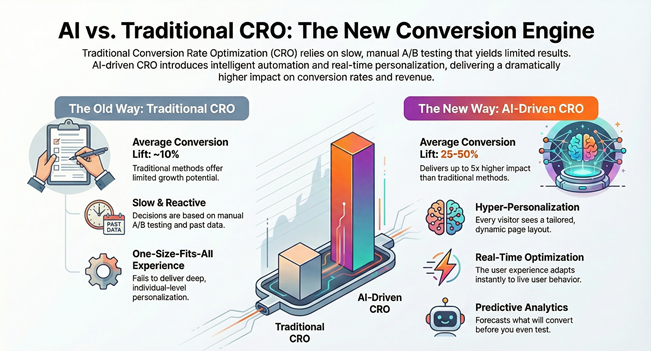
Traditionally, CRO involves human experimentation. How? Certainly, web pages need variants to test different elements like headlines or button colours, along with waiting weeks to see significant statistical changes. Waiting is a slow procedure, and it indicates a reactive approach.
Now imagine how AI has improved everything.
Smart AI-driven CRO leverages machine learning algorithms, which constantly analyse how users interact with landing pages in real time. Overall, it runs A/B testing logically after learning the data of millions of clicks, scrolls, time spent on the page, and purchase patterns.
This real-time assessment helps in anticipating changes in KPIs. It automatically optimises content and landing page components as per individual experiences.
So, the introduction of AI has enabled marketers to optimise user journeys, content delivery, and conversion paths using data-driven insights rather than assumptions; an approach that now defines effective digital marketing execution.
Why AI-Driven CRO Matters in 2026
Multiple reasons are behind the ruling of AI-driven CRO.
1. Hyper-Personalisation at Scale
AI is emerging as the best tool for personalisation by the day. The substantial thing is that it defines this experience for every individual visitor, but not only for a broad audience. The credit goes to its sophisticated algorithms that analyse behaviour, historical data, and other external signs with lightning-fast speed. This type of automatic assessment produces
- Product recommendations
- Landing page optimisation recommendations
- Promotional offers to attract customers
- Messaging tone, like promotional or informative
2. Predictive Optimisation Instead of Reactive Testing
Traditionally, CRO uses a reactive approach; for instance, it favours testing changes and seeing what works or not. AI, on the flip side, leverages models to project recommendations. For sure, machine learning and complementary systems make it faster, like how to optimise the layout, update pricing, or UX to speed up or increase conversions. It enables systems to anticipate them before the models or algorithms are deployed.
When algorithms leverage a part of data during testing, it prevents wasted efforts and also accelerates automatic learning. This way, brands centralise their focus on high-impact transformations, which data backs, but not the guesswork.
3. Automated Multi-Channel CRO
Earlier, manual A/B testing was lengthy, which led to testing on limited platforms. But in 2026, e-commerce will expand its horizon from websites and mobile apps to social media, marketplaces, voice interfaces, and more. It means that AI will cover every touchpoint.
With smart AI systems, optimizing landing pages and content over various online platforms will be normal. And digital marketing in AI will guide how to do it accurately after analysing cross-channel behaviour.
It can be like a case where a shopper who checked out a product on Facebook may see a tailored landing page on the website. Or a mobile app user who abandoned a cart may see a dynamic email with lots of discounted offers in the inbox for quick conversions.
All in all, aligning personalised experiences across channels will be automated. AI will remove all roadblocks to improve customer journeys.
4. Real-Time Adaptation and Contextual UX
Real-time adaptation seems like a dream. But AI can make it real. Smart AI systems can efficiently adapt user experience elements in real time. It can be understood via an example, which says that this technology can throw the best value deals and flexible payments after observing that the user is loving exploring premium products.
This is how it creates a magnificently intuitive user experience and anticipation, which is far beyond static designs.
5. Smarter Experimentation and Faster Learning
Smarter experiences involve AI, which is not going to settle down with automating tests. It indeed designs such experiments using advanced algorithms that they themselves choose what to test. So, this procedure is completely opposite of predicting anything randomly. Eventually, this practice will dramatically reduce the duration to make an impact.
As happens today, where marketers run dozens of tests every quarter, brands can run high-value tests more frequently, like every week. This fast frequency will speed up agility, enabling e-commerce teams to become trendsetters instead of chasing them.
FAT Insights
Fact: According to a case study by Experro, AI-driven CRO practices increase conversion rates by 25% to 50% or more. This is going to happen more aggressively in 2026.
Analysis: This much improvement cannot be expected unless AI-driven personalisation, real-time adaptation, and predictive modelling take charge. This is a proactive approach guided by algorithms that constantly refine themselves with new data automatically over time.
Takeaway: Now, the fact and its deep analysis clearly convey that competition is going to be tough, and data-powered insights will do so. The one who uses it quickly and wisely will improve conversion rates in e-commerce. So, the revenue will be more if things are going to be aligned strategically.
Challenges and Best Practices
Though this advanced technology is excellent, its success relies on thoughtful implementation.
- Data Quality and Privacy
AI works according to data. If it’s flawless and fresh, the result will be outstanding. Clean, structured, and ethically gathered data guides for better insights. Brands must maintain transparency and manage consent for data collection to comply with privacy regulations.
- Human Oversight
AI is smart enough to do multiple tasks. But strategically, a human is stronger. So, companies must set business goals and leverage contextual insights to guide the AI while measuring algorithms ethically.
- Integration with Martech Stack
Existing marketing technology, covering analytics platforms, CRM systems, and customer data platforms, is necessary for the success of AI-driven CRO. This is an expensive deal. Also, the siloed system completely blocks insights that AI needs.
Conclusion
AI-driven conversion rate optimisation is constantly evolving the way merchants sell online. In 2026, e-commerce will be more aggressive as AI can automate data-driven insights. So, the era of hyper-personalisation, predictive optimisation, and real-time website optimisation is on. Artificial intelligence will certainly empower brands to convert more visitors into customers by building high-performing digital websites through data-driven intelligence. Though challenges will be there, AI will power CRO to boost by integrating faster learning cycles, higher engagement, and growth rate.